
Kibale National Park is a national park in western Uganda, protecting moist evergreen rainforest. It is 766 square kilometers (296 sq mi) in size and ranges between 1,100 meters (3,600 ft) and 1,600 meters (5,200 ft) in elevation. Despite encompassing primarily moist evergreen forest, it contains a diverse array of landscapes. Kibale is one of the last remaining expanses to contain both lowland and montane forests. In eastern Africa, it sustains the last significant expanse of pre-montane forest.
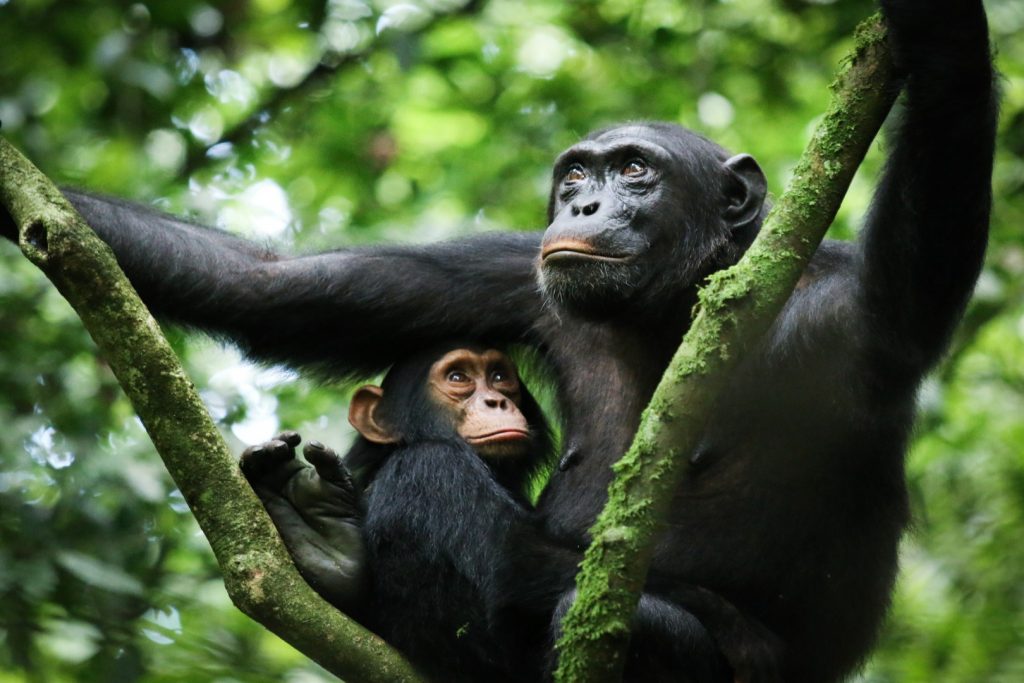
The Park was gazetted in 1932 and formally established in 1993 to protect a large area of forest previously managed as a logged forest reserve. The Park forms a continuous forest with Queen Elizabeth National Park. This adjoining of the parks creates 180 kilometers (110 mi) wildlife corridor. It is an important ecotourism and safari destination, well-known for its population of habituated chimpanzees and twelve other species of primates. It is also the location of the Makerere University Biological Field Station.
Two major tribes, the Batooro and Bakiga, inhabit the area around the park. They use the park for food, fuel, and other resources with the help of the Uganda Wildlife Authority. In the last century, the population around the park has increased by sevenfold. This is speculated to be because the park directly brings in revenue for those living around it and the tourism industry creates jobs. In addition, many farmers believe that the soil is better for growing crops year-round. This increase in the population has caused the area around the park to be divided and developed or turned into plantations and farmland, and demand for firewood asserts pressure on the park’s wildlife habitat. Cutting trees for fuel has already strained many of the forest areas outside Kibale.
Kibale National Forest has one of the highest diversity and concentration of primates in Africa. It is home to a large number of endangered chimpanzees, as well as the red colobus monkey (status: Endangered) and the rare Lhotse’s monkey (Vulnerable).
There are 13 species of primates in Kibale National Park. The Park protects several well-studied habituated communities of common chimpanzees, as well as several species of Central African monkey including the Uganda Mangabey (Lophocebus ugandae), the Uganda Red Colobus (Procolobus tephrosceles) and the Lhotse’s monkey. Other primates that are found in the park include the black-and-white colobus (Colobus guereza) and the blue monkey (Cercopithecus mitis). The park’s population of elephants travel between the park and Queen Elizabeth National Park. Other terrestrial mammals that are found within Kibale National Park include red and blue duikers, bushbucks, sitatungas, bushpigs, giant forest hogs, common warthogs, and African buffalo. The carnivores that are present include leopards, African Golden Cats, servals, different mongooses and two species of otter. In addition, lions visit the park on occasion. Bird life is also prolific. The park boasts 325 species of birds, including the olive long-tailed cuckoo, western tinkerbird, two species of pittas (African and green-breasted) and the grey parrot. The ground thrush (Turdus kibalensis) is endemic to Kibale National Park.